What Is a Golf Handicap? The Simple Answer & Why It Matters
This post contains affiliate links. As an Amazon Associate, we earn from qualifying purchases.
A golf handicap is a numerical measure of your potential playing ability, calculated from your best recent scores and adjusted for course difficulty. It’s designed to let golfers of different skill levels compete fairly by indicating how many strokes you should receive or give during a round.
Most people think their handicap is their average score. That’s wrong. It’s closer to your “average best” performance. This misunderstanding leads to frustration when a 15-handicap player shoots a 95 and feels like they’ve failed. They haven’t. The system expects variance.
Here’s exactly what a golf handicap is, how the World Handicap System crunches your numbers, and how to use it to actually play fair games with anyone.
Key Takeaways
- Your Handicap Index is not your average score. It’s calculated from your best eight Score Differentials out of your last 20 rounds, which adjusts your raw score for course difficulty.
- You need a Course Handicap for every round. Your Handicap Index is portable, but you must convert it using the specific Course Rating and Slope Rating of the tee set you’re playing.
- The system includes caps and reductions. A “soft cap” slows rapid handicap increases, and an “exceptional score reduction” automatically lowers your index after a stellar round.
- For handicap purposes, your maximum score on any hole is a Net Double Bogey. This prevents one disaster hole from wrecking your handicap calculation.
- Getting an official handicap requires joining a club or authorized association and posting scores through a system like GHIN.
How Is a Handicap Index Calculated?
The Handicap Index formula looks intimidating. Ignore the algebra. Focus on the inputs. Your index is based on your best eight “Score Differentials” from your most recent 20 rounds. A Score Differential is not your raw score. It’s your score adjusted for how hard the course was that day.
The Score Differential formula is: (Adjusted Gross Score – Course Rating) x (113 / Slope Rating). The 113 is a standard Slope Rating baseline. The Playing Conditions Calculation (PCC) can further adjust the differential if weather or course conditions made the day abnormally easy or hard.
Let’s say you shoot 90 from tees with a Course Rating of 71.5 and a Slope Rating of 125. Your Adjusted Gross Score is 90 (after applying the Net Double Bogey max per hole). Plug it in: (90 – 71.5) x (113 / 125) = 18.5 x 0.904 = 16.7. Your Score Differential for that round is 16.7. The system collects these differentials from your last 20 rounds, picks the best eight, averages them, and multiplies by 0.96. That final number is your Handicap Index.
TL;DR: Your Handicap Index is an average of your best eight recent performances, each adjusted for course difficulty. It’s not your raw average score.
The 8-of-20 Rule and Why It Matters
Using only the best eight scores out of twenty builds the system around your potential, not your consistency. A player with twenty scores might have eight differentials around 12.0 and twelve around 20.0. Their index will be near 12.0. This is why a 12-handicap can occasionally shoot 95. Their index reflects their good days, not their bad ones.
The number of scores required changes as you build your record.
| Number of Acceptable Scores | Scores Used in Calculation |
| ——————————- | —————————— |
| 3 (54 holes) | Lowest 1 Score Differential |
| 5 (90 holes) | Lowest 2 Score Differentials |
| 7 (126 holes) | Lowest 3 Score Differentials |
| 9 (162 holes) | Lowest 4 Score Differentials |
| 11 (198 holes) | Lowest 5 Score Differentials |
| 13 (234 holes) | Lowest 6 Score Differentials |
| 15 (270 holes) | Lowest 7 Score Differentials |
| 17 (306 holes) or more | Lowest 8 Score Differentials |
This graduated scale means your early handicap is more volatile. Once you have 20 scores, it stabilizes around your demonstrated ability.
Safeguards: Caps and Exceptional Scores
The system has two key controls to keep handicaps honest and responsive. The first is the soft cap and hard cap. If your calculated Handicap Index tries to rise more than 3.0 strokes above your Low Handicap Index (the lowest index you’ve held in the last year), the increase is slowed (soft cap) or stopped (hard cap). This prevents a slump from sending your handicap skyrocketing.
The second is the exceptional score reduction. If you post a Score Differential that is at least 7.0 strokes better than your current Handicap Index, your index is automatically reduced. The reduction is -1.0 for a differential 7.0–9.9 strokes better, and -2.0 for 10.0 strokes or better. This means a great round immediately improves your handicap.
Common mistake: Not posting a terrible round because you think it will “ruin” your handicap — the 8-of-20 rule and the caps protect you from a single bad day, but missing scores creates an inaccurate index that doesn’t reflect your true ability.
What Do the Numbers Mean? Scratch, Bogey, and Beyond
A zero Handicap Index is a “scratch golfer.” They expect to shoot the Course Rating on a typical good day. An 18-handicap is roughly a “bogey golfer,” averaging about a bogey per hole. These terms are benchmarks.
Positive handicaps exist for highly skilled players. A +2.0 handicap means the player is expected to shoot two strokes better than the Course Rating. They give strokes in competition.
Your handicap number directly influences your equipment choices. A player looking for golf balls for high handicappers needs maximum forgiveness and help getting the ball airborne. A low handicap player equipment focus is on spin control and feel. The best golf balls guide covers this spectrum.
Course Handicap vs. Playing Handicap: The Critical Conversion
This is where people get lost. Your Handicap Index is a portable, universal number. But you don’t use it directly to get strokes. You must convert it to a Course Handicap for the specific course and tees you’re playing. The formula is: Handicap Index x (Slope Rating / 113) + (Course Rating – Par). Many clubs and apps do this math for you.
The Playing Handicap is the number of strokes you actually use during the round. It’s usually your Course Handicap, but it can be adjusted by a handicap allowance (like 85% for a team event) or if players are competing from different tees.
I played a member-guest where my Handicap Index was 8.2. The course we played had a Slope Rating of 130 from the blue tees. My Course Handicap calculated to 10. The event used a 90% allowance, so my Playing Handicap was 9. I got 9 strokes on the designated holes. My partner, with a 14.1 index, got 13 strokes. We tied the match because the system worked.
Ignoring this conversion is the most common practical error. You can’t just say “I’m a 10” and take 10 strokes everywhere. A Slope Rating of 145 turns that 10 into a 13. A Slope Rating of 105 turns it into a 9. The official USGA article on handicap basics stresses this point.
How to Get Your First Handicap Index
You can’t calculate an official Handicap Index yourself. You need to be a member of a golf club or an authorized golf association that participates in the World Handicap System. In the U.S., this is typically done through the GHIN (Golf Handicap and Information Network) system administered by state and regional associations like the SCGA.
- Join a club or association. Many public courses offer “e-clubs” for handicap purposes without requiring full membership.
- Post acceptable scores. Play by the Rules of Golf, over at least 9 holes (combined for 18-hole posting), on a rated course during its active season. Your score must be certified (by you or a playing partner).
- Post through the system. Use your club’s posting terminal, the GHIN app, or a website. Post every round, good or bad.
- Watch your index develop. After three 18-hole scores, you’ll get an initial handicap. It will update every night as you post more scores.
Posting is the habit. I’ve seen players with years-old handicaps that are stale because they stopped posting. Their index doesn’t reflect their current game, and they get too many strokes in matches. It’s a quiet form of sandbagging.
The Rules: Acceptable Scores and Net Double Bogey
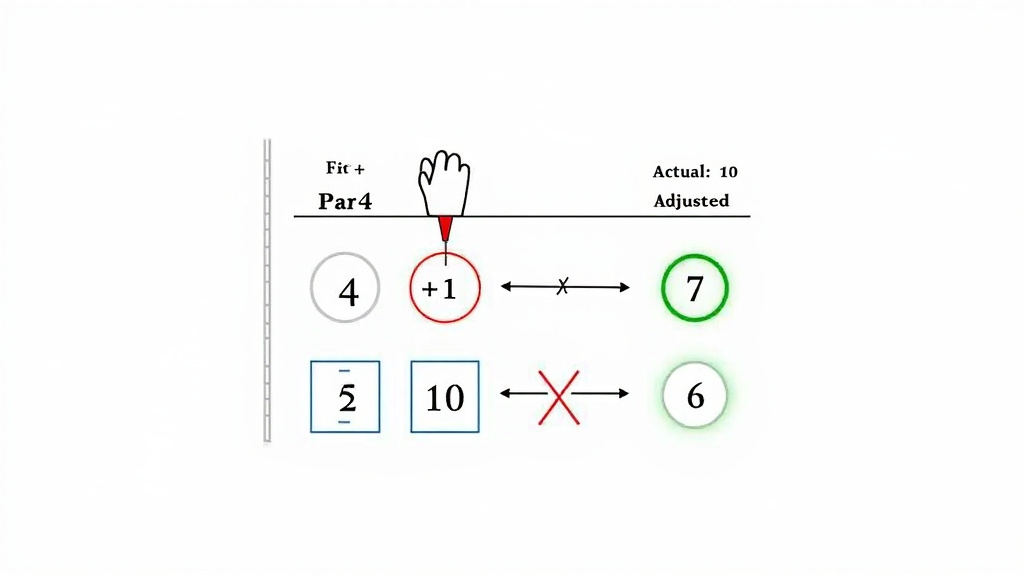
For a score to be acceptable for handicap posting, the round must meet specific conditions. It must be played according to the Rules of Golf, over at least 9 holes, on a course with a current Course Rating and Slope Rating, during the course’s active season (no winter posting in frozen regions). The player’s score must be certified.
The most important scoring rule for handicap purposes is the Net Double Bogey maximum. For any hole, your maximum score for handicap calculation is par + 2 + any handicap strokes you receive on that hole. If you’re a 10-handicap and get a stroke on a par-4 hole, your max is 4 + 2 + 1 = 7. If you blow up and shoot a 10, you record a 10 for your actual round score, but your Adjusted Gross Score for handicap uses a 7.
This rule prevents a single hole from distorting your Score Differential. It’s a mercy. The Wikipedia entry on golf handicaps details the historical evolution of this and other equity rules.
Why Handicaps Aren’t Used in Pro Golf
Professional tournaments are played at scratch. Every competitor starts at zero. There’s no stroke adjustment. The handicap system is for amateur golf, where the primary goal is inclusive, fair competition across a wide skill range.
This also means a “pro handicap” is meaningless. When a teaching pro has a Handicap Index, it’s for their amateur play, not their professional status. The official 2024 Handicapping Rules are written for amateur golf administration.
Frequently Asked Questions
What’s a good handicap for a beginner?
typical beginner might start with a handicap in the 30-40 range after their first few scores. As they improve, it will drop rapidly. “Good” is relative. An index below 20 is considered solid recreational play. Below 10 is very good.
How often does my handicap update?
Under the World Handicap System, your Handicap Index is recalculated daily, provided you have posted new scores. Updates typically occur overnight.
Can I have a handicap without joining a club?
No. An official Handicap Index requires membership in a club or authorized association that administers handicaps. This ensures oversight, peer review, and adherence to the rules. Some online services offer “trackers,” but these are not official for competition.
Why did my handicap go up after a bad round?
Because the bad round’s Score Differential might have replaced a better one in your best-eight average. If your worst differentials in your last 20 are 25.0 and you post a 26.0, it might not change the average. But if you post a 30.0 and it pushes out a 20.0, your average rises. The caps limit extreme jumps.
What’s the difference between Slope Rating and Course Rating?
Course Rating represents the expected score for a scratch golfer from a given tee set. Slope Rating represents the relative difficulty of the course for a bogey golfer compared to a scratch golfer. A higher Slope Rating (e.g., 135) means the course is significantly harder for the average player. Choose your tees based on Slope if you’re a mid-handicap; it directly impacts your Course Handicap.
Before You Go
Your golf handicap is a tool, not a trophy. It exists to facilitate fair games, not to label you. Understand that it measures potential, not average. Convert it to a Course Handicap every time you play. Post all your acceptable scores, trust the Net Double Bogey rule, and let the system’s caps protect you from wild swings.
Use it to find the right golf ball selection for mid handicappers or gear for 12 handicap golfers. Use it to set realistic expectations. A 15-handicap shooting 85 is a great day. Shooting 100 is a bad day. Both are within the system’s design. The number works if you work with it.
