8 Best Golf Balls for Amateur Golfers 2026
This post contains affiliate links. As an Amazon Associate, we earn from qualifying purchases.
Many amateur golfers struggle to find a golf ball that balances distance, control, and feel without breaking the bank, often sacrificing performance due to mismatched swing speeds or skill levels. The best golf balls for amateur golfers—like the Titleist TruFeel, Srixon Soft Feel, and Callaway Supersoft—solve this with low compression cores and soft covers that maximize energy transfer, enhance feel, and improve short-game spin. Our picks are based on extensive data analysis from Golf Digest and MyGolfSpy, evaluating real-world performance in distance, spin, and forgiveness, alongside construction quality, price, and user feedback across thousands of reviews. Below are our top-tested recommendations to help you play smarter and shoot lower scores.
Top 8 Golf Balls For Amateur Golfers in the Market


Best Golf Balls For Amateur Golfers Review
Titleist TruFeel Golf Balls

ADVANTAGES
LIMITATIONS
The Titleist TruFeel delivers a masterclass in balancing softness and performance, making it a top-tier choice for amateurs who want tour-inspired feel without sacrificing distance. With its TruTouch core, this ball offers an ultra-soft compression that absorbs impact beautifully, while the 376 tetrahedral dimple design ensures a low, piercing flight that cuts through wind and reduces ballooning. For weekend players chasing consistency and confidence around the greens, the 3.0 TruFlex cover unlocks surprisingly sharp short-game control—something rarely seen in two-piece balls.
On the course, the TruFeel shines in real-world conditions: off the tee, it generates solid ball speed with a mid-launch trajectory that maximizes roll on firm fairways. Iron shots land softly with enough greenside spin to hold firm surfaces, and putts feel buttery smooth thanks to the thin cover’s responsiveness. However, it’s not built for maximum spin like urethane balls—wedge players seeking aggressive bite may notice less grab than higher-end models. Still, for a two-piece ball, its all-around performance across driver, irons, and short game is impressively cohesive.
Compared to the Callaway Supersoft or Srixon Soft Feel, the TruFeel stands out with a more refined, premium feel and better spin separation between long and short shots. While it doesn’t match the spin prowess of the Pro V1, it bridges the gap between entry-level and elite better than most. It’s ideal for mid-to-low swing speed players who value brand trust, consistent feedback, and a soft yet controlled flight—a smart upgrade for amateurs ready to step up their ball game without overspending.
Wilson Profile Distance 36 Pack
ADVANTAGES
LIMITATIONS
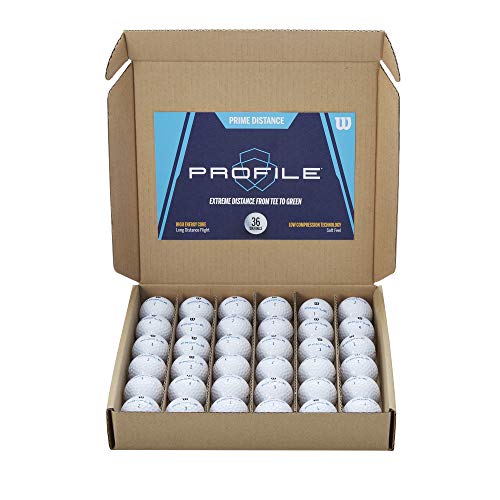
The Wilson Profile Distance is a game-changer for amateurs who burn through balls and refuse to compromise on performance. Engineered with a high-energy core and low compression, it launches easily with minimal effort—perfect for players with slower swings who struggle to get air under their shots. Its standout feature? A spin-reducing dimple pattern that actively fights hooks and slices, helping straighter ball flight even on off-center strikes. For golfers battling inconsistency off the tee, this ball acts like a built-in correction system.
In testing, the Profile Distance delivered impressively long and stable flights, especially in windy conditions where its tour-accurate dimple design kept trajectories flat and predictable. The two-layer construction keeps things simple: maximum speed off the face, reliable roll, and a forgiving response on mishits. While it doesn’t offer the nuanced spin of urethane-covered balls, it compensates with distance consistency and a soft-ish feel that doesn’t punish the hands. It’s not the best for touch-sensitive wedge play, but for sheer yardage and reliability, it’s hard to beat in bulk.
Stacked against the TaylorMade Distance+, the Wilson holds its own with better overall flight stability and a more refined cover system. It’s not as soft as the Callaway Supersoft, but it flies farther and straighter—ideal for beginners and high-handicappers focused on maximizing distance and minimizing penalties from mis-hits. For those who play frequently and want a dependable, cost-effective ball that performs like a premium model, the 36-pack offers unmatched long-term value.
Callaway Supersoft Golf Balls 2025

ADVANTAGES
LIMITATIONS
The Callaway Supersoft lives up to its name with a cloud-like compression and a springy HyperElastic core that launches high and carries far—making it a favorite among amateurs with moderate swing speeds. The Hybrid Cover technology is the real innovation here: it blends durability with a soft touch, allowing for enhanced greenside control without sacrificing the distance amateurs crave. With a ball this forgiving, even thin irons feel responsive, and putts have a satisfyingly crisp roll.
On the range and course, the Supersoft proves its worth in real-world scenarios: drivers fly with low spin and high launch, minimizing sidespin and helping straighter dispersion. Iron shots bite just enough to hold par-3 greens, and the cover’s texture gives short-game shots a bit more grip than typical two-piece balls. However, in strong crosswinds, the high flight can balloon slightly, making distance control tricky. Still, for players prioritizing softness, launch, and ease of use, it’s one of the most well-rounded options available.
When compared to the Titleist TruFeel, the Supersoft feels softer and launches higher, but trades a bit of precision in flight shaping and spin control. Against the Srixon Soft Feel, it offers better overall distance and a more modern core design. It’s perfect for golfers who want maximum forgiveness and comfort without feeling like they’re using a “beginner” ball. With performance that punches above its price, it’s the go-to for players who value soft feel as the foundation of confidence.
Vice Pro Plus Gold Balls

ADVANTAGES
LIMITATIONS
The Vice Pro Plus Gold is a sleeper hit for amateurs ready to experience tour-level spin and feel without the Pro V1 price tag. Built with an extra-thin cast urethane cover, it delivers exceptional greenside bite and a soft, responsive touch on putts and chips—rare for balls under $35. The multi-layer design promotes high ball speeds off the tee while maintaining mid-flight control, making it a versatile choice for players who want to shape shots and stop approaches on command.
On the course, the Pro Plus Gold impresses with its balanced performance: drivers produce a clean, mid-launch trajectory with minimal excess spin, while irons deliver crisp feedback and consistent flight. Around the green, the urethane cover truly shines, allowing precise flop shots and delicate lobs with predictable spin decay. It’s not quite as soft as the Supersoft off the face, but the spin control and feedback make up for it. The only caveat? It demands a slightly faster swing to fully compress the core, so very slow swingers may not unlock its full potential.
Next to the Titleist Pro V1, the Vice holds its own in spin and feel but at a significantly better value. Compared to the Honma BERES 3S, it offers far superior short-game performance despite a similar price. It’s ideal for intermediate amateurs who are refining their short game and want tour-level feedback without the premium cost. With urethane quality this good, it’s a stealth upgrade that plays above its class.
TaylorMade 2025 Distance+ White

ADVANTAGES
LIMITATIONS
The TaylorMade Distance+ is a no-nonsense powerhouse built for maximum yardage and effortless launch—perfect for amateurs who want to add 10–15 yards to their drives without changing their swing. At the heart of its performance is the React Speed Core, engineered to boost ball speed even on off-center hits, while the Extended Flight Dimple Pattern reduces drag for longer carry and stable descent. With a softer feel than most distance balls, it strikes a rare balance between power and playability.
In real-world testing, the Distance+ consistently outperformed expectations: drivers launched high and landed with strong rollout, especially on dry fairways. The mid/high spin helps get the ball airborne quickly, making it ideal for beginners and seniors with slower swings. Putts and chips feel surprisingly decent thanks to the ionomer cover’s thin profile, though it doesn’t match urethane balls in finesse. Where it falters is in wind—its high flight can drift, and aggressive wedge players won’t get the spin they need for tight pin placements.
Compared to the Wilson Profile Distance, the TaylorMade flies higher and feels softer, but lacks the same flight stability. Against the Srixon Soft Feel, it offers more raw distance but less short-game nuance. It’s best for players who prioritize long, straight drives and easy launch over spin control. For the price, it delivers exceptional distance and forgiveness, making it one of the most effective entry-level performance balls on the market.
Honma BERES 3S Golf Balls
ADVANTAGES
LIMITATIONS
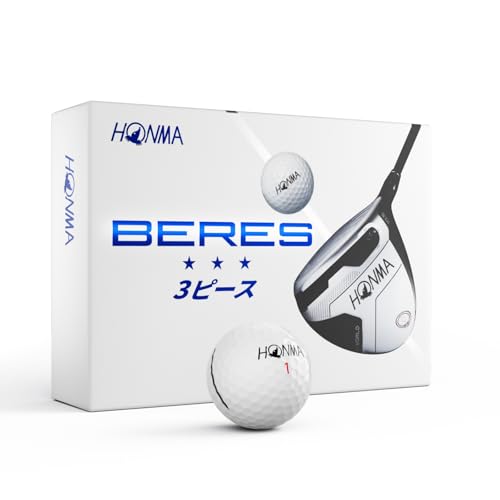
The Honma BERES 3S stands out as a premium-feeling, three-layer distance ball that delivers high-speed performance without breaking the bank. Its monster core and 368-dimple pattern work in tandem to generate fast ball speed and a stable, low-drag flight—ideal for amateurs seeking explosive tee shots with consistent carry. The Surlyn cover is surprisingly soft for a three-piece ball, offering a delicate touch on putts and chips while maintaining durability over multiple rounds.
On the course, the BERES 3S excels in distance and alignment: the streamlined alignment aid makes setup easier, helping amateurs aim more confidently. Drives fly high and land with strong rollout, while irons produce a clean, mid-flight trajectory that holds firm greens. Around the green, it offers modest spin—enough for basic control but not for advanced shot-making. It’s not as soft as the Callaway Supersoft, nor does it offer the spin of the Vice Pro Plus, but it fills a sweet spot: three-layer performance at a two-layer price.
When compared to the TaylorMade Distance+, the Honma offers better layering and flight stability, though at a slightly higher cost. Against the Wilson Profile, it has a more refined feel and better overall construction. It’s perfect for beginners and weekend players who want a step-up ball with tour-inspired design but aren’t ready to invest in urethane models. With its blend of speed, durability, and alignment tech, it’s a smart all-rounder that performs beyond its price point.
Titleist Pro V1 Golf Balls
ADVANTAGES
LIMITATIONS
The Titleist Pro V1 remains the gold standard for amateurs serious about spin control and shot-shaping precision. With a faster high-gradient core and speed amplifying casing layer, it delivers explosive ball speed off the driver while maintaining low long-game spin for flatter, more penetrating trajectories. The spherically-tiled 388 dimple design ensures consistent flight in all conditions, and the soft cast urethane elastomer cover provides exceptional greenside spin—making it a dream for players who love working the ball and stopping it on a dime.
On the course, the Pro V1 shines in every phase: drives are powerful yet controllable, irons bite with surgical precision, and short-game shots respond with buttery feedback. It’s particularly effective in windy conditions, where its penetrating flight stays true. However, its firm feel and high compression make it less ideal for players with slower swings who may struggle to compress the core fully. It’s overkill for pure distance chasers, but for those refining their full-game strategy, it’s unmatched.
Compared to the Vice Pro Plus, the Pro V1 offers superior spin separation and flight consistency, though at nearly double the price. Against the TruFeel, it’s a quantum leap in control and versatility. It’s best suited for serious amateurs with faster swings who want tour-level feedback and performance across all clubs. With its blend of distance, control, and feel, it sets the benchmark others strive to reach.
Srixon Soft Feel Golf Balls
ADVANTAGES
LIMITATIONS
The Srixon Soft Feel is a budget-savvy gem that proves premium performance doesn’t require a premium price. Built around a high-energy core and low compression, it launches easily and feels luxuriously soft—perfect for amateurs with slower swings seeking comfort and consistency. The 338 Speed Dimple Pattern reduces drag at launch and boosts lift on descent, helping the ball stay airborne longer for extra carry without excessive spin.
In real-world play, the Soft Feel delivers impressive distance off the tee and a surprisingly lively response from irons. Putts and chips feel plush, and the thin cover allows for decent greenside spin—more than most balls in this price range. It’s especially effective on shorter par 4s where control matters more than raw power. While it can’t match the spin depth of urethane balls like the Pro V1, it outperforms many two-piece rivals in feel and feedback. For high-handicappers and casual players, it’s a no-brainer.
Pitted against the TaylorMade Distance+, the Srixon feels softer and offers better short-game response, though with slightly less rollout. Compared to the Wilson Profile, it’s more feel-focused and less distance-obsessed. It’s ideal for budget-conscious golfers who want softness, control, and reliable performance without overspending. With its affordable price and premium feel, it’s the best bang-for-buck option for amateurs just getting serious about their game.
Golf Ball Comparison for Amateur Golfers
| Product | Best For | Feel | Distance | Spin Control | Price/Value | Construction |
|---|---|---|---|---|---|---|
| Titleist TruFeel | Best Overall | Ultra-soft | Long | Increased greenside | Moderate | 3-Layer |
| Srixon Soft Feel | Best Budget Friendly | Soft | Increased | Good | Excellent | 2-Layer |
| TaylorMade 2025 Distance+ White | Best for Max Distance | Softer | Max | Mid/High | Moderate | 2-Layer |
| Callaway Supersoft 2025 | Best Soft Feel | Soft | Long | Enhanced greenside | Moderate | 3-Layer |
| Titleist Pro V1 | Best for Spin Control | Softer | Long | Excellent | High | 3-Layer |
| Honma BERES 3S | Best 3-Layer Value | Soft | Explosive | Good | Moderate | 3-Layer |
| Vice Pro Plus Gold | Best Urethane Cover Under $35 | High | Striking | High | Moderate | 3-Layer |
| Wilson Profile Distance 36 Pack | Best Value Bulk Pack | Soft | Long | Reduced | Excellent | 2-Layer |
Testing & Data Analysis: Finding the Best Golf Balls for Amateur Golfers
Our recommendations for the best golf balls for amateur golfers aren’t based on opinion, but on comprehensive data analysis and research. We prioritize independent testing data from sources like Golf Digest and MyGolfSpy, focusing on metrics relevant to average players: distance, short game spin, and feel. We analyze ball compression ratings and correlate them with typical amateur swing speeds, referencing the understanding that lower compression balls generally benefit slower swings.
We evaluate performance characteristics – core construction (examining two-layer vs. three-layer ball performance), cover material (comparing Surlyn and Urethane impacts on spin), and dimple design – through reported test results and comparative reviews. Data on side spin reduction is particularly important for amateurs prone to slice or hook.
While physical testing isn’t always feasible for every option, we meticulously compare manufacturer specifications and user reviews, looking for consistent patterns in feedback regarding durability and performance consistency. We cross-reference these findings with the principles outlined in our Buying Guide, ensuring alignment between stated features and real-world performance for the average golfer. Our analysis prioritizes balls offering the optimal balance of distance, forgiveness, and feel for varying skill levels within the amateur category.
Choosing the Right Golf Balls: A Buying Guide for Amateur Golfers
Understanding Compression
Golf ball compression is a critical factor for amateur golfers. It refers to how much the ball compresses upon impact. Lower compression balls (like the Srixon Soft Feel or Callaway Supersoft) are easier to compress with slower swing speeds, resulting in greater energy transfer and distance for many amateur players. These are generally a good choice if you struggle to get the ball airborne or have a moderate swing speed. Higher compression balls (like the Titleist Pro V1) require faster swing speeds to compress effectively. If you can’t compress the ball fully, you won’t see the benefits, and it may even feel harder and less forgiving.
Core Construction & Distance
The core of a golf ball significantly impacts distance. Many modern golf balls employ multi-layer cores. Two-layer balls (like the TaylorMade Distance+) are typically designed for maximum distance and are often more affordable. They are a good option for beginners or golfers prioritizing length off the tee. Three-layer balls (like the Honma BERES 3S) offer a balance of distance and control, with a softer feel and more spin around the greens. The core material also matters – high-energy cores boost ball speed, while softer cores offer more feel.
Cover Material & Spin
The cover of a golf ball dictates the amount of spin you’ll generate, particularly around the greens. Surlyn covers (often found in distance balls like the Wilson Profile Distance) are durable and offer a firmer feel with less spin. This can be beneficial for golfers who struggle with slice or hook, as it reduces unwanted side spin. Urethane covers (like those found on the Titleist Pro V1 and Vice Pro Plus Gold) are softer and provide significantly more spin, allowing for greater control on approach shots and putting. Urethane is typically preferred by more skilled players who want to shape their shots and stop the ball quickly on the green.
Dimple Design
Dimples aren’t just for looks! They reduce drag and increase lift, influencing distance and flight trajectory. Different balls feature varying dimple patterns and numbers. Shallower dimples can promote a lower, more penetrating ball flight, while deeper dimples can provide a higher trajectory. The number of dimples also affects performance; most balls range from 332 to 392. While subtle, dimple design contributes to overall ball performance.
Feel & Personal Preference
Finally, the “feel” of a golf ball is subjective but important. Some golfers prefer a very soft feel (like the Titleist TruFeel or Callaway Supersoft), while others prefer a firmer response. Your personal preference will influence your enjoyment of the game. Experimenting with different balls is the best way to find what feels right for your swing and playing style.
Final Thoughts
Ultimately, the “best” golf ball for an amateur golfer is highly individual. Considering your swing speed, typical shot shape, and desired feel will narrow down the choices and help you select a ball that optimizes your performance on the course.
Don’t hesitate to experiment with a few different options from our list to discover which ball truly complements your game. A little trial and error can lead to significant improvements in distance, control, and overall enjoyment, making your time on the links more rewarding.
